This page is curated from AIONA's real development log. Every entry below began as a commit in the product's history; we group related work, translate engineering language into what it means for a practice, and leave the internal plumbing out. Newest first. Where a month included an operational incident, it appears here too, because how a platform behaves when something goes wrong belongs in the record.
September 2026
- Grade my Xero grades what the automation coded. The first line of every Xero grade is now the automation headline for that book: how many bank lines were coded with no human touch, how many of those the review disagrees with, and the VAT at risk on them. AIONA cannot see how Xero's assistant matched a line, so it infers automation from reconciled feed lines with no document behind them and says so on the report. Read-only as before; nothing is written back. Free for practices until 3 November 2026. Grade what JAX did.
- Where your data goes, in one sentence. The site footer now carries it on every page: AIONA reads Xero with read-only consent, writes nothing back, keeps each client's rules to that client, and never uses your data to train anything.
August 2026
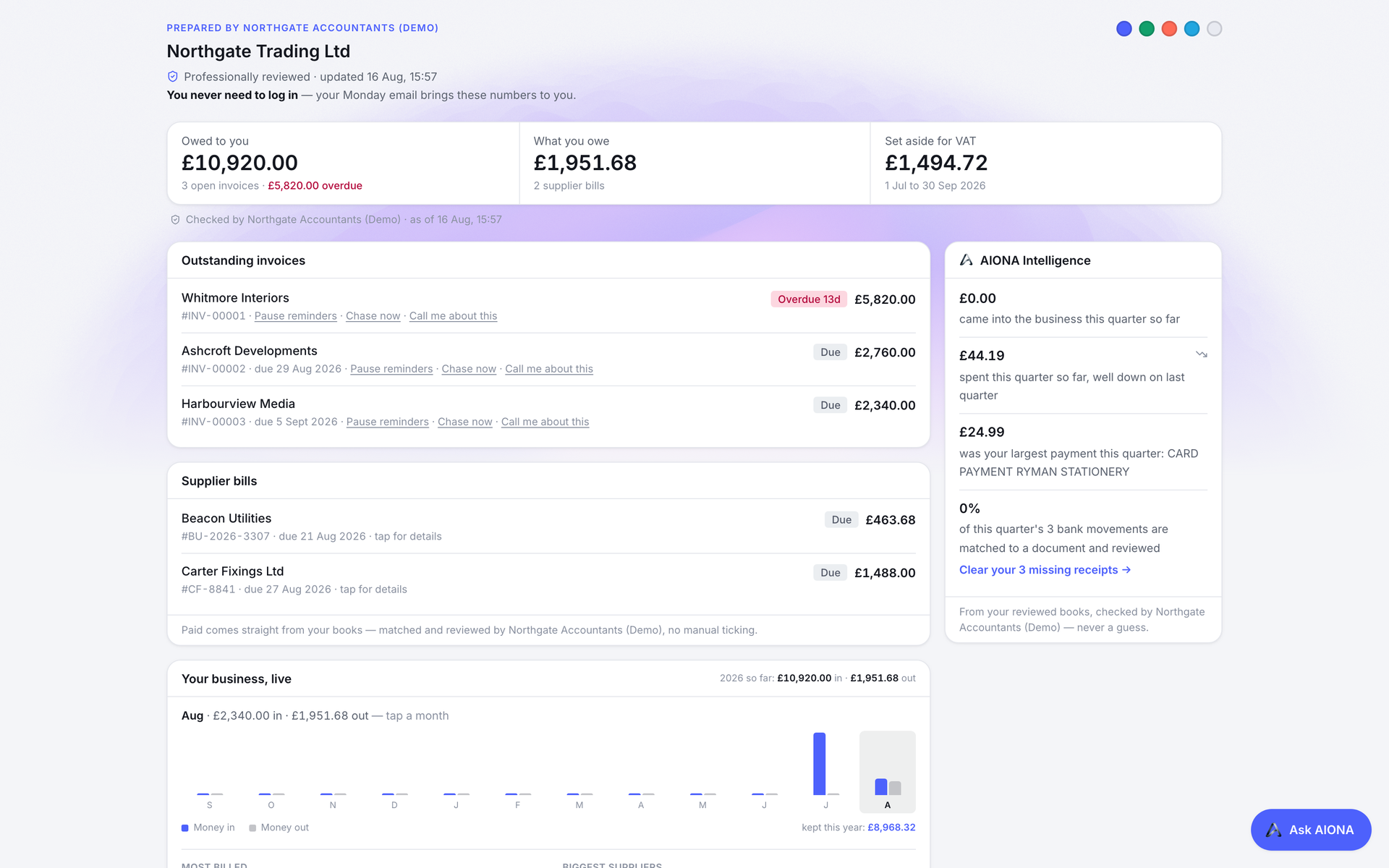
- Client portal launched. Clients get a no-login portal through a secure link: a weekly Monday Money digest under the practice's brand, approval requests answered in one tap, missing-receipt uploads that land against the right transaction, and document upload plus email-in. More on the portal.
- Messages reach the right people. Two-way messaging between a client and their practice now routes to the client's engagement team rather than the whole firm, and who works on which client is recorded as a fact, not a guess.
- Answers with receipts on the client portal. The portal's AI chat attaches the source-document rows behind each answer, and clients see live report figures, a tax timeline, a cash outlook and their year-end pack.
- Self-serve signup. A new account is created with its practice in place from the first screen. Your first client company remains free.
- Intake capacity limits and a memory postmortem. A large photo batch exhausted the intake worker's memory, so concurrency is now capped and document reading runs in its own process, so a heavy upload batch cannot slow the rest of the application.
- Security hardening sweep. A review across authentication, session token handling, inbound webhooks and dependencies, plus a dedicated isolation audit of the new client portal. How AIONA approaches security.
- Groundwork for HMRC recognition. The required legal declaration now appears where the MTD rules say it must, and fraud-prevention headers are sent on every relevant call, not only on submissions. Our software recognition application is still in progress; VAT submission continues through your existing route until it completes.
- Billing that tracks the book. The bill follows your live client count on every change, your first client company is free, and the billing copy was rewritten for plain honesty. Pricing.
- A faster drafts inbox. Bulk actions work on mixed selections with per-item results, failures are visible instead of silent, and review reasons about dates say plainly what needs checking.
July 2026
- Accuracy measurement built in. A nightly grading loop now scores every capture against what reviewers actually confirmed, field by field, and each confidence band carries its measured record inside the product. Public figures follow when the sample is large enough to mean something; the definitions are on the accuracy page.
- Read-only Xero grading. Connect a client's Xero and get a graded report against their own chart of accounts, with precision guardrails so AIONA never asserts a mis-coding it cannot defend. It reads only; it cannot write anything back. Since September 2026 the report opens with the automation headline: how many lines the software coded with no human touch, how many are wrong, and the VAT at risk.
- Reconciliation rebuilt around actions. One reconcile page, a plausibility gate that flags doubtful matches for review instead of hiding them, a review gate enforced on the server rather than only in the interface, and an end to merchant-name guesses being presented as bank matches. How reconciliation works.
- HMRC Enquiry Defence Pack. A pack that walks from each figure to the journal to the source document behind it, produced under one design system now shared by every PDF and spreadsheet export.
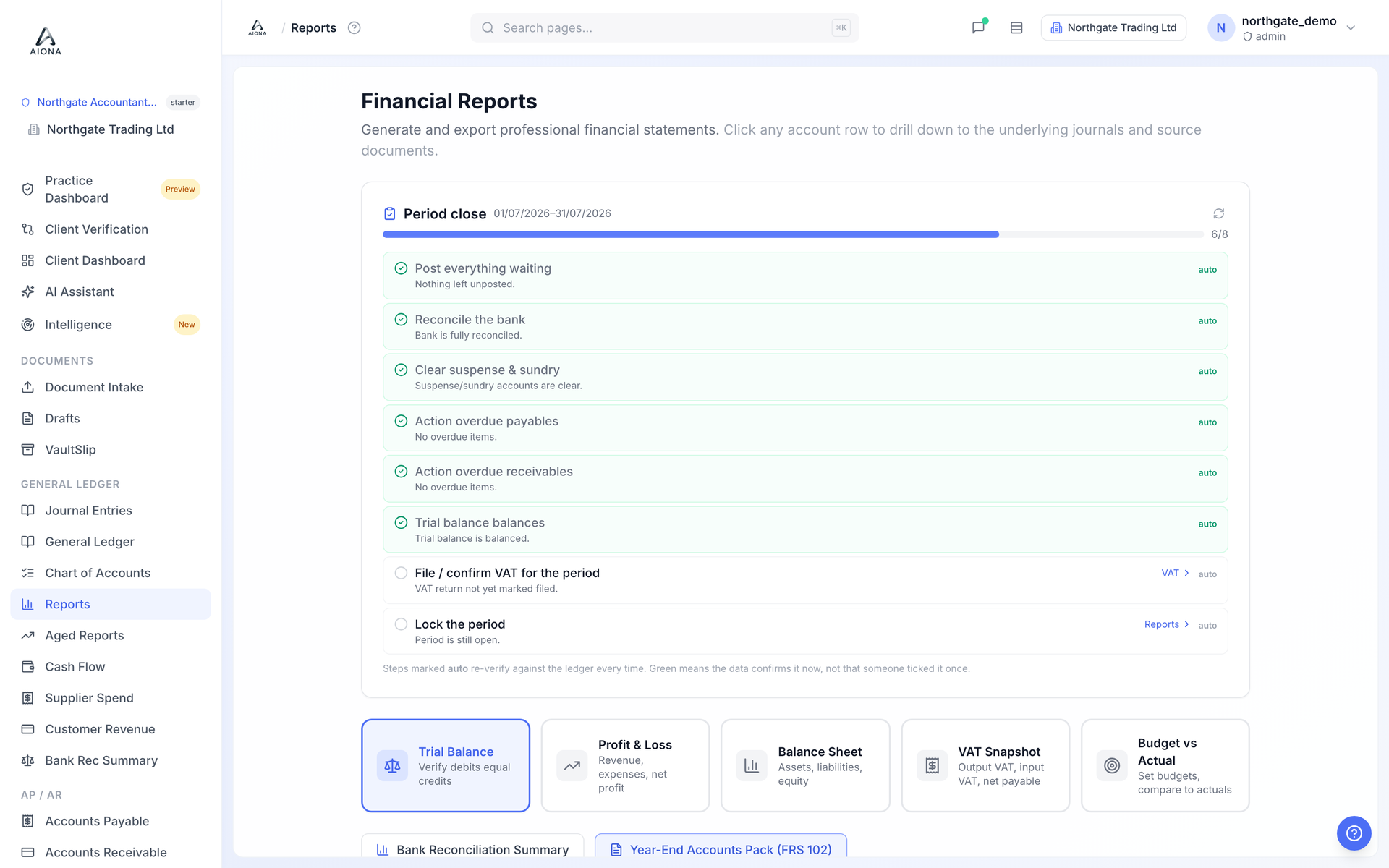
- Period close and reporting honesty. Green on the close checklist now means the ledger confirms it at that moment, a tick cannot bury a live problem, the trial balance ties to the balance sheet, and exports match the screen.
- Company intelligence for the practice. A deadline radar across clients, a watchlist with live register alerts, figures read from filed accounts with an honest unverified tier for image-only filings, and due-diligence actions recorded in the audit trail.
- Ten practice features in one sprint. A missing-records chase pack, vendor-rules memory with visible track records, a self-verifying period-close companion, a day-start briefing, a fee-opportunity finder, a debtor book, an AML evidence file, an identity-verification campaign pack ahead of the statutory deadline, a prospect radar, and Ask AIONA on every number.
- Per-client pricing. The product moved to one per-client price with unlimited users and AI included; seat tiers were removed everywhere. Pricing.
- Backups you can trust. Nightly encrypted database backups are verified by an actual restore, and an uptime probe checks the portal, the API and the website every two hours, paging when nobody can log in rather than when a single host blips.
- Deep audit sweeps. Successive whole-codebase audits hardened reconciliation, posting, VAT, payroll, exports and reports batch by batch; malformed requests now answer as client errors rather than server faults, and every fix landed with a regression test.
June 2026
- Tenant isolation built into the database layer itself. Every table carries the tenant boundary, and background jobs such as scheduled sweeps and the email-in intake now rolling out run inside the boundary of the tenant they serve, so isolation does not depend on application code remembering to filter.
- The ledger defends itself. The database now refuses an unbalanced journal and refuses writes into a closed period, and VAT returns are prepared from the immutable snapshot taken at close.
- Adversarial security audits. Internal red-team style reviews closed cross-tenant access defects, regression tests and an automated scoping check now guard against the same class of bug returning, and authentication was hardened with fail-closed defaults, rate limiting and anti-enumeration measures.
- Working UK reconciliation end to end. Deterministic categorisation against the UK chart of accounts, a run-the-books test harness that exercises the whole posting path, and one-click statement import with a clear empty state on the reconcile page.
- An assistant that answers from the ledger. The AI assistant reads the real ledger, stays strictly on accounting, and will not invent journal references, documents or payments. It also knows which page you are looking at.
- Honesty sweep. Mock dashboards were replaced with real wiring or removed, fabricated numbers stopped being presented as live, and irreversible money actions gained explicit confirmations.
- Data residency pinned. Hosting in the UK with AI document processing in the EU, enforced by a startup gate that refuses to boot on an incomplete production configuration.
- Dependency vulnerabilities cleared. Every known vulnerability across the application's dependencies was remediated in one pass, and file uploads were hardened alongside.
- Practice-grade administration. Real user management, deletion tooling for UK GDPR requests, and separate single-purpose tokens for verification, password reset and invitations.
May 2026
- Confidence tiers enforced at the gate. Every captured document scores GREEN, AMBER or RED; low confidence blocks posting outright, and AMBER requires an explicit confirmation before anything reaches the ledger. What the tiers mean.
- Per-line coding with a learning layer. Line items route to their own accounts rather than inheriting a vendor-level guess, and the practice's corrections outrank the defaults from then on, scoped to that practice alone.
- Three-level drill-down in reports. From the trial balance, profit and loss or balance sheet, through account activity, to the journal, to the source document behind it.
- Guided reconciliation. An action-first redesign: learned categorisation rules managed in the interface, confirmed matches teaching future suggestions, and transfers between your own accounts settling correctly instead of being expensed.
- Wider statement import, and Open Banking groundwork. Bank statements now import from PDF and photographs as well as CSV, with friendly errors instead of gibberish. The foundations for Open Banking feeds, now rolling out, landed here with scheduled sync and transfer-aware enrichment.
- Year-end and ledger-control toolkit. An FRS 102 Section 1A accounts pack, emailed customer statements with ageing, batch payment runs with a full audit trail, and aged debtor and creditor reports.
- Duplicates caught at the door. Incoming documents are fingerprinted by content, a suspected duplicate is surfaced with a link to the original, and the confirm interlock sits before posting, not after.
- A reviewable "why". The reasoning panel shows the real decision path behind every suggested coding, and rejected drafts keep their reason in the audit trail.
- Audit log export. The full audit log exports to CSV in one click.
Entries are curated for readability; the underlying history is the product's real commit log.