When bookkeeping software posts something wrong, the software company does not sign the return. You do. The engagement letter, the professional indemnity policy and the HMRC enquiry all carry your practice's name, not the vendor's. That should change how you evaluate: less time on feature tours, more time on what the software does when it is wrong, what it records, and what leaving costs.
Below are seven groups of questions you can put to any vendor. For each, we explain why it matters, describe what a good answer sounds like, and then give AIONA's own answer plainly, so you can hold us to the same standard. Where our answer includes something unfinished, we say so.
1. What happens below the confidence threshold?
- When the software is not sure about a document, what exactly happens?
- Is confidence a gate that stops posting, or just a score used for sorting?
- Can a low-confidence entry reach the ledger without a human seeing it?
Why it matters. Silent automation errors do not announce themselves. They surface at the VAT quarter or at year end, as your problem. A vendor that cannot name the precise consequence of low confidence is telling you the consequence is nothing.
A good answer. A specific threshold with a specific consequence: below it, nothing posts until a person decides. "Our AI is highly accurate" is an answer to a different question. Ask to watch a document fail.
AIONA's answer. Every document we read is scored GREEN, AMBER or RED; low confidence blocks posting outright, and nothing posts without human sign-off. How we measure this is on our accuracy page, and we have written about what confidence scores actually mean.
2. Are overrides and corrections logged?
- If staff override the software's suggestion, is that recorded, with a reason?
- Can the record of an override be edited or deleted later?
- Do corrections train the system, and is that learning shared with other firms?
Why it matters. In an enquiry you need to show who decided what, and why, at the time. And if corrections feed a model shared across customers, one firm's habits can quietly shape another firm's books.
A good answer. Overrides require a stated reason, the log is tamper-evident rather than a table someone can tidy, and learning from corrections stays inside your practice.
AIONA's answer. Overrides need a written reason, recorded in a tamper-evident audit log. Corrections do teach the system, and that learning is scoped to your practice only.
3. Can posted entries be edited in place?
- Can a posted journal be changed or deleted after the fact?
- How are mistakes corrected, and is the correction itself visible?
- Does every entry link back to its source document?
- Are control accounts protected from direct posting?
Why it matters. A ledger that can be edited in place cannot prove what the figures were when you filed. That weakens you in an enquiry and undermines the digital record MTD expects you to keep.
A good answer. No in-place edits at all. Mistakes are corrected by reversal, so the error and the fix are both on the record, and the evidence sits on the journal itself rather than in a folder nearby.
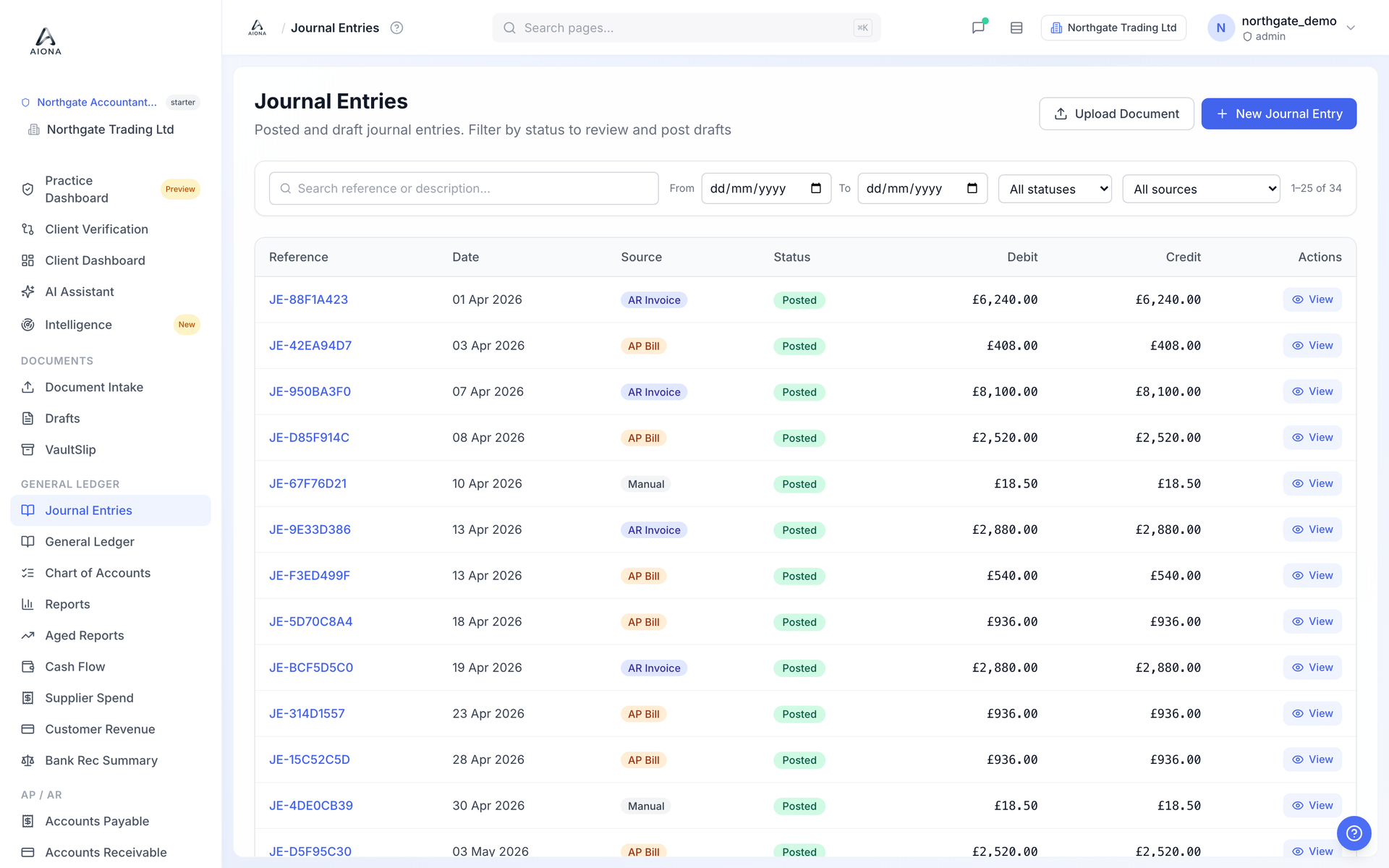
AIONA's answer. The ledger is immutable and corrections post as reversals. Every journal links to its source document, and the full UK chart of accounts is seeded on day one with control accounts locked.
4. Where does the data live, and what does leaving cost?
- Where is client data hosted, and where does AI document processing run?
- What can you export, in what formats, and how often?
- Is there an exit fee, a notice period, or an export request queue?
Why it matters. Exit risk is part of the price. A vendor that makes leaving slow or expensive has decided your data is their retention strategy.
A good answer. Named jurisdictions, full export in open formats available to you at any time without asking, and no fee to leave.
AIONA's answer. Hosting is in the UK and AI document processing runs in the EU; the detail is on our security page. Full CSV and Excel export is available at any time, and there is no exit fee.
5. How is the price structured?
- Is it per client, per user, or metered on AI usage?
- What happens to the bill when you add reviewers?
- What would the AI cost at your real volumes in a busy month?
Why it matters. Metered AI is a bill you cannot quote a fixed fee against. Per-user pricing taxes review, and review is the last thing a practice carrying the liability should be discouraged from doing.
A good answer. A unit that maps cleanly to how you charge clients, no meter on the AI, and no charge for putting more eyes on the work.
AIONA's answer. £24 per client per month, £19 from your 26th client and £15 from your 76th, with unlimited users and all AI included. Your first client company is free. Details are under pricing.
6. What happens to digital links if you migrate mid-quarter?
- If you move mid-quarter, how does the digital journey from record to return survive?
- Is the VAT return computed from the ledger, or can figures be keyed by hand?
- How does bank data arrive during the transition: working feeds today, or feeds "coming soon"?
- Is the software on HMRC's recognised list, and have you checked that list yourself?
Why it matters. MTD requires an unbroken digital link from record to return, and a mid-quarter migration is exactly where links break. Recognition claims are checkable in minutes, because HMRC publishes its list.
A good answer. A return computed from posted entries with no manual keying, a preserved record of the figures at submission, honest dates on bank feeds, and a recognition status that matches HMRC's own list.
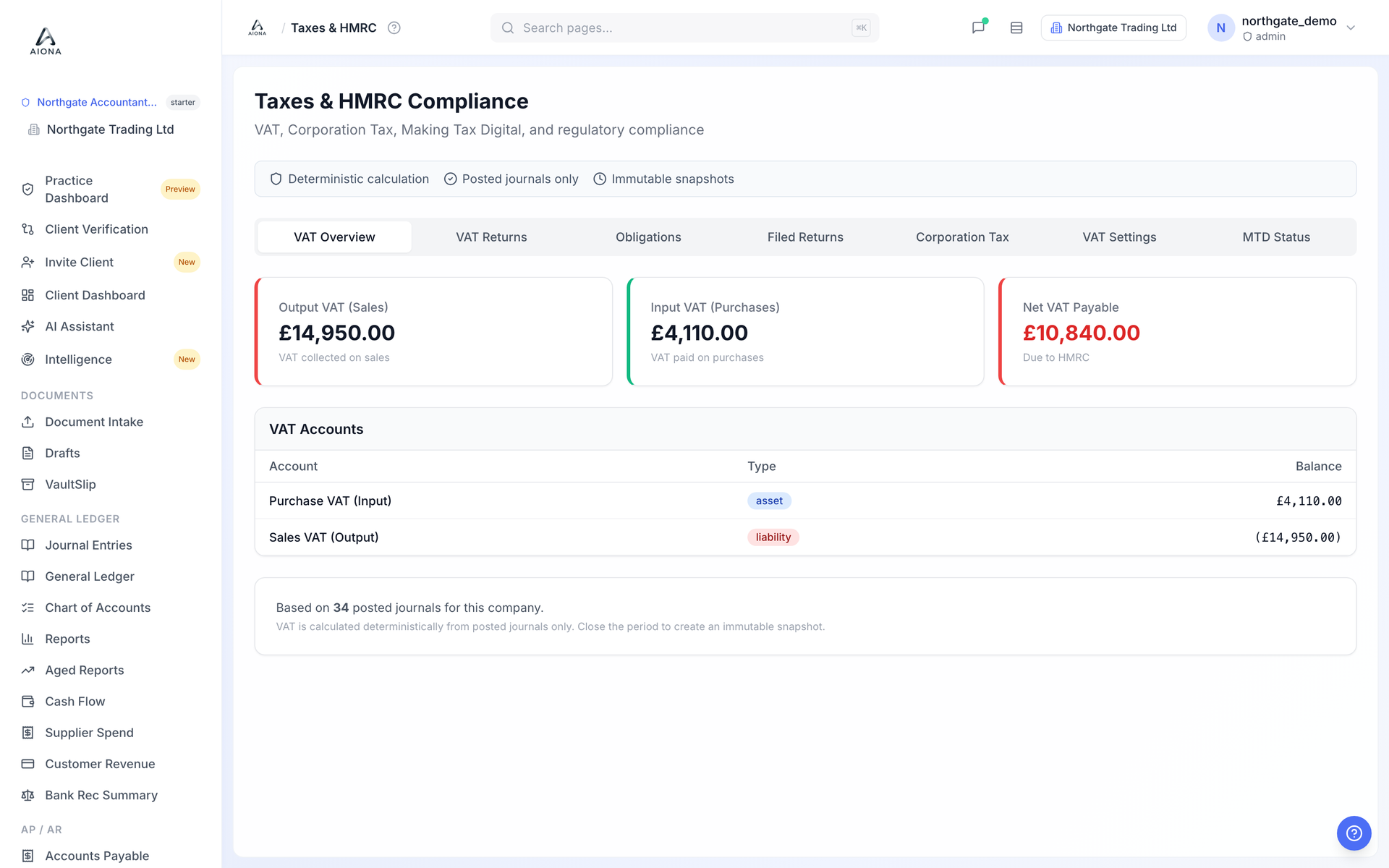
AIONA's answer. The 9-box is computed deterministically from posted journals, with an immutable snapshot at period close. Statement import (CSV, OFX, QIF, PDF) is the supported bank route today; Open Banking feeds are rolling out. Our HMRC recognition application is in progress and not yet complete, so VAT submission goes through your existing route until it is. Check that statement, and every vendor's, against HMRC's published list.
7. Who is behind the company, and how do you verify them?
- What is the legal entity and company number?
- Are they registered with the ICO, and under what number?
- If the company failed, how would you get the books out?
Why it matters. You are handing client financial data to a counterparty, and small vendors do fail. Ten minutes on public registers verifies more than any brochure, and a vendor who bristles at being checked has answered a question too.
A good answer. Entity details offered unprompted and matching Companies House and the ICO register, plus an exit that does not depend on the vendor's cooperation, because you can already export everything yourself.
AIONA's answer. We are AIONA LTD, Companies House number 16606520, ICO registration ZC189017. Because full export is available to you at any time, getting your books out never depends on our cooperation, or our survival.
Use it on everyone
Take these questions into every demonstration on your shortlist, ours included. Vendors worth trusting answer in specifics; the rest answer in adjectives. If you want the case for review before anything posts, read review-first versus silent automation, or simply put these questions to us directly.